You want to land in Rome and fly home from Athens. Or fly to Bangkok, work your way south, and leave from Singapore. The obvious approach is to book two separate round trips, throw away the halves you don't need, and eat the cost. Almost nobody needs to do that.
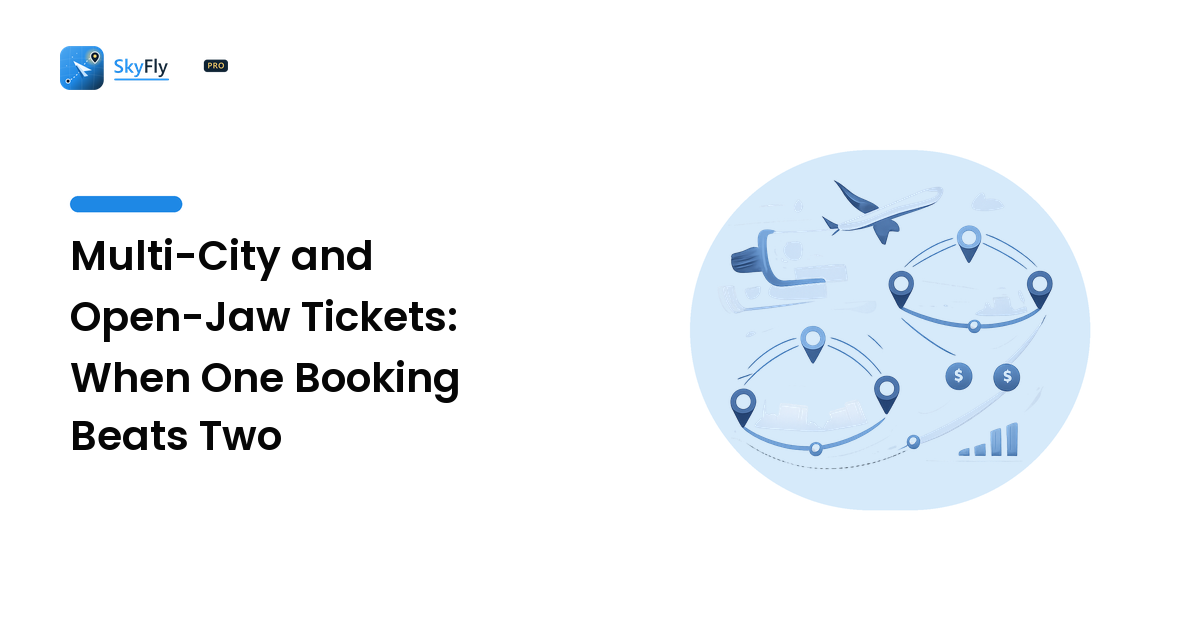
Here's the takeaway: an itinerary that enters one city and leaves from another is a normal, bookable product called an open jaw, and it usually prices at roughly the average of the two round-trips involved — not double. The real decision isn't whether it's possible. It's whether to buy your trip as one ticket, which buys you protection, or as separate tickets, which sometimes buys you a lower price and always transfers the risk to you.
The vocabulary, quickly
- Multi-city is the search mode: two or more flights with dates and city pairs you specify individually. It's the third tab next to Round Trip and One Way on essentially every search tool.
- Open jaw is the itinerary shape: you fly out to A, and home from B (a destination open jaw), or out from your home city and back to a different one (an origin open jaw). Both ends different is a double open jaw. You book all of these through the multi-city search.
- Stopover is different again: a deliberate long pause in a connecting city, sometimes free on the same ticket, sometimes not permitted by the fare rules. It's a feature of one journey, not a second one.
Why open jaws are cheaper than people assume
International fares are typically constructed from directional halves. A round-trip fare is, loosely, half of the outbound pricing plus half of the return pricing — which is why an open jaw often lands near the average of the two relevant round trips rather than the sum. If a return to Rome and a return from Athens are broadly similar in price, an in-Rome/out-Athens ticket tends to sit near that same level, not at 200% of it.
Two consequences worth internalising:
- Skipping the surface segment costs little. The train from Rome to Naples, or the ferry between Greek islands, is your problem to arrange — but the fare doesn't punish you for it the way people expect.
- The asymmetry matters. If one end of your trip is a notoriously expensive airport and the other is a cheap one, an open jaw lets you land at the cheap one and leave from the expensive one (or vice versa) and pay something in between. On a symmetric round trip you pay for the expensive airport twice.
This does not hold everywhere. On short-haul low-cost carriers — the Ryanair, easyJet, Wizz, Southwest, Spirit family — every flight is priced as an independent one-way. There is no round-trip discount to average, so "open jaw" is simply two one-ways, and you should book it that way.
One ticket vs. separate tickets: the actual trade-off
This is the decision that costs people money and missed flights, so be deliberate about it.
What a single ticket buys you
When all your flights sit on one booking reference (PNR), the airline owns the whole journey:
- Missed-connection protection. If leg one runs late and you miss leg two, the airline rebooks you at its cost. That is the single biggest reason to pay a modest premium for one ticket.
- Through-checked bags. Your luggage is usually tagged to the final destination, so you don't reclaim and re-check in the connecting city.
- One cancellation policy. A schedule change or cancellation on any leg gives you rights over the whole itinerary rather than one segment.
- Shorter legal connections. Airlines publish minimum connection times per airport; on one ticket you're allowed to use them. On separate tickets you should not.
What separate tickets buy you
- Access to carriers that can't be combined. Most low-cost airlines don't interline, so no system will sell you a Ryanair leg and an Emirates leg on one ticket. If the cheap option is a non-interlining carrier, separate is the only shape available.
- Sometimes, a genuinely lower price. Especially when one leg is a low-cost carrier and the other is long-haul.
- Mixing cash and points. You can redeem miles for the expensive long-haul leg and pay cash for the short hop. On one ticket you generally can't.
The rule I'd actually apply
If the legs are on separate tickets, treat the connection as if you were two different travellers meeting: give it an overnight, or at minimum a very generous buffer, and prefer connecting at your home base or at a city you're happy to be stuck in. If the price gap between one ticket and two is small, take the one ticket — you are buying insurance that pays out exactly when your trip is at its most stressful. The wider decision framework here is in our flight booking strategy guide.
How to actually search a multi-city itinerary
Complex routings are hidden behind a tab, and several tools price them badly. Work through it in this order:
- Price the two round trips first, as a baseline. Home→A return, and home→B return. Write both numbers down. Your open jaw should land somewhere near their average. If it comes back near their sum, the tool has priced it as two one-ways and you should try elsewhere.
- Run the multi-city search. Enter leg 1 as Home→A and leg 2 as B→Home, with your real dates. Google Flights, Kayak, and Skyscanner all support this; so do most airline sites, which is where you should check next.
- Check the operating airline's own site. Airline sites frequently price their own multi-city itineraries better than aggregators, and they're more likely to construct a valid fare across partner metal within an alliance.
- Try the mirror. Swap which city you fly into and which you fly out of. The two directions can price differently, and the trip often works either way round.
- Price the separate-tickets version too, including bag fees on each carrier, so you're comparing like with like. The general fare-hunting tactics in how to find cheap flights apply to each leg.
- Sanity-check the surface segment. An open jaw is only a saving if the ground link between A and B is cheap and reliable. A high-speed train is ideal; a nine-hour overnight bus you'll dread is not.
If a routing simply won't price online — some legitimate multi-carrier constructions won't — that's the classic case for a human travel agent or the airline's phone line, which can build fares the web booking engine won't attempt.
Where open jaws quietly shine
- Overland trips. Any itinerary where you're travelling A→B by land or sea: Italy by train, Vietnam north-to-south, a US one-way drive.
- Two-hub countries. Landing at one major gateway and departing another is often barely more expensive than repeating one, and it saves you a backtrack day.
- Award travel. Many loyalty programs explicitly permit open jaws and sometimes stopovers on award tickets, which can make one redemption cover a much richer trip. Fare rules vary by program — read them before you plan around them.
- Cruises and events. Anywhere your trip's shape is fixed by something other than the flight.
Fitting the routing to the trip rather than the other way round is really an itinerary-design question; our trip planning guide covers building the ground half.
The mistakes that cost the most
- Assuming double the price and never checking. The most common and most expensive error.
- Tight self-transfers. A 90-minute connection between two separate tickets is a bet, not a plan.
- Forgetting bags on separate tickets. You usually reclaim and re-check, which needs time and may mean paying a second bag fee.
- Ignoring which airport in a metro area. Landing at one city airport and departing another can be fine, or can be a two-hour cross-town transfer at 5am. Check the specific airports, not just the city.
FAQ
Is an open-jaw ticket more expensive than a round trip?
Usually only slightly, and sometimes less. Because international fares are built from directional halves, an open jaw commonly prices near the average of the two round trips involved rather than the sum. Price both round trips first so you have a baseline to judge the quote against.
Can I book a multi-city ticket with two different airlines?
Yes, if the airlines interline — typically the case within an alliance or between partners with an agreement. If one of them is a low-cost carrier that doesn't interline, no system can sell it as one ticket and you'll need separate bookings.
How long should I leave between flights on separate tickets?
Far longer than a normal connection, because nobody will rebook you if the first flight is late. Many experienced travellers won't self-connect on the same day at all for a long-haul leg; an overnight in the connecting city removes the risk entirely.
Does the 24-hour cancellation rule apply to multi-city bookings?
Where the rule applies to a booking, it applies to the itinerary as a whole rather than to individual legs — which is one more argument for a single ticket. Confirm the terms shown at checkout, since they depend on where you book and which regulator covers the sale.
What's the difference between a stopover and an open jaw?
A stopover is a long, deliberate pause in a connecting city while still on one journey to a final destination. An open jaw means your journey genuinely ends in one city and restarts in another, with you covering the gap by land, sea, or a separate flight.
The economics of any open jaw come down to what each individual leg normally costs. Look up both city pairs — airlines serving them, typical duration, stops, and the cheaper months — in the route guides at SkyFly Pro, then price the multi-city version against those two baselines. Setting a fare alert on each leg while you decide costs nothing.