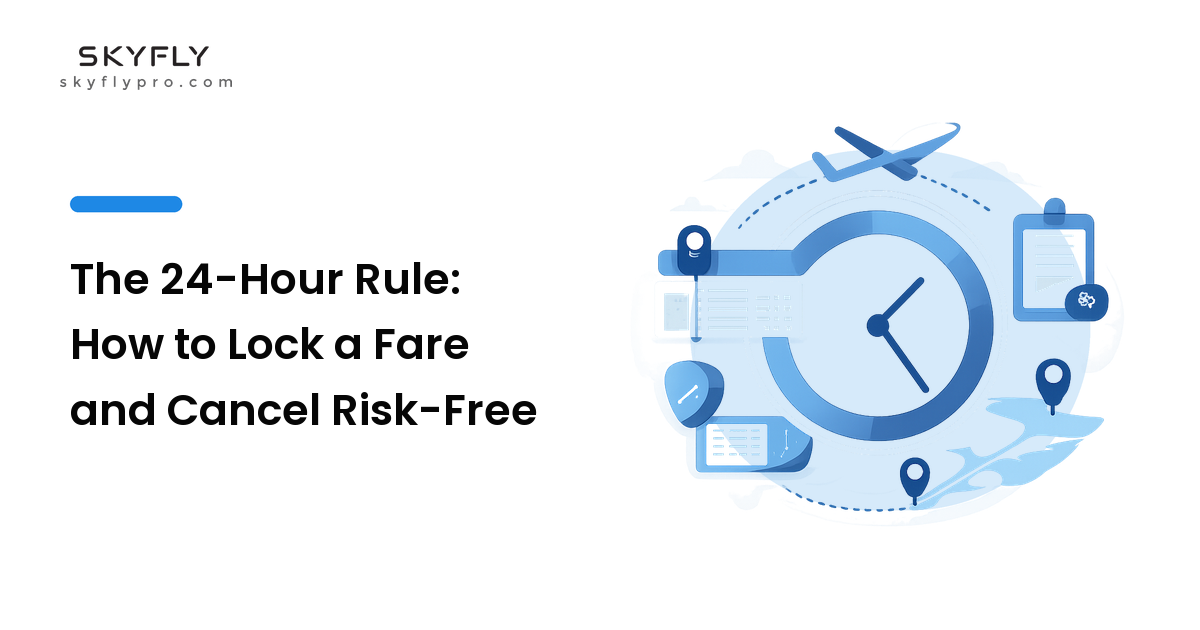
There's a quiet advantage built into how flights are sold in the United States, and most travelers never use it on purpose. When you buy a qualifying ticket, you can usually cancel it for a full refund within 24 hours of booking — no fee, no fare penalty, no questions. Used deliberately, that window turns booking from a high-pressure gamble into a calm, reversible decision. You can grab a good fare the instant it appears, then take the rest of the day to confirm the trip works before the money is truly gone.
The short version: book first to lock the price, then verify in the next 24 hours, and cancel free if anything doesn't add up. The rule exists, it's reliable, and it's the closest thing to a risk-free "hold" most travelers will ever get. But it has real fine print — get the conditions wrong and the window doesn't apply.
This piece sits alongside our broader flight booking strategy guide; think of the 24-hour rule as one specific, high-value tool inside that wider booking discipline.
What the 24-hour rule actually is
In the U.S., the Department of Transportation requires airlines to let passengers either hold a reservation at the quoted fare for 24 hours or cancel a completed booking within 24 hours for a full refund — provided the ticket was bought at least seven days before departure. Airlines choose which of the two versions to offer, and most offer the cancel-for-full-refund version.
That distinction matters. It is not a "change your mind cheaply" discount — it is a genuine full refund of what you paid, back to your original payment method, as long as you act inside the window and meet the conditions. It applies to flights to, from, and within the United States on most carriers selling to U.S. customers.
What it is not: it is not a global law. Outside the U.S., free 24-hour cancellation is a courtesy some airlines extend, not a guarantee. And it is not a license to repeatedly "reserve" seats you don't intend to fly — that's a separate behavior airlines watch for and discourage.
Why this is genuinely useful
The value isn't the refund itself — it's what the window lets you do calmly:
- Lock a good fare before it moves. Fares change without warning. If you've found a price at the low end of its normal range, booking it freezes that price while you confirm the rest, instead of losing it to hesitation.
- Verify the details without pressure. Names matching ID exactly, the right airport code for cities with several, layover length, baggage rules, and whether your dates truly work — all of it can be checked after you've secured the price.
- Coordinate before you commit. Confirm a hotel, a day off work, or a travel companion's schedule, then keep the flight or release it free.
In other words, the rule lets you separate two decisions that usually get rushed together: "is this price good?" and "is this whole trip right?" You answer the first immediately and the second carefully.
A worked example
Say you're watching a route that normally runs about $420 round trip. On a Tuesday morning a fare drops to $318 for your dates — clearly the low end of the range, and worth booking. But your return depends on a meeting that may move, and you haven't checked whether the outbound flight leaves from the city's main airport or its smaller one an hour away.
Without the rule, you face a bad choice: book now and risk a $200 change fee if the meeting shifts, or wait to confirm and likely watch the $318 fare vanish.
With the rule, you book the $318 fare immediately to lock the price. Over the next few hours you confirm the meeting is fixed, check that the flight uses the main airport, and verify your name matches your passport. Everything holds, so you keep the ticket — and you've paid $318 instead of the $420 baseline, with zero risk taken. Had the meeting moved or the airport been wrong, you'd have cancelled inside 24 hours for a full refund and lost nothing. The window converted a $100-plus saving from a gamble into a sure thing.
The fine print that voids the window
This is where travelers get burned. The rule has conditions, and missing one means it simply doesn't apply:
- The seven-day requirement. The booking must be made at least seven days (168 hours) before the flight departs. Buy a ticket for travel five days out and the 24-hour refund right generally does not apply.
- It must be booked directly with the airline. The DOT requirement is on the airline. Many third-party resellers and online travel agencies impose their own cancellation policies, which can be stricter, and you may be dealing with the agency rather than the carrier. Booking direct keeps you squarely under the rule.
- Hold vs. refund — know which you have. A few airlines satisfy the rule by offering a 24-hour hold at booking instead of a refund after purchase. If you've already paid, you want the refund version; if you're offered a hold, use that path instead of completing payment.
- The clock starts at booking, not midnight. The 24 hours run from the moment of purchase. Book at 9 p.m. and you have until 9 p.m. the next day — not until end of day.
- Refund timing. The cancellation is immediate, but the money returning to your card can take a few business days. That's normal; the ticket is cancelled the moment you confirm.
Common mistakes and why they cost you
- Booking through a reseller and assuming the rule applies. The cheapest sticker price is often a third party. If their policy is stricter, you've traded the refund right for a few dollars — a poor swap when you specifically want the safety net. Book direct when you intend to rely on the window.
- Cutting the seven-day line too close. Last-minute trips are exactly when plans are shakiest, yet that's when the rule most often doesn't apply. Don't count on a free cancel inside the final week.
- Treating the window as "free until I'm sure." The rule is for confirming a real intended trip, not for parking multiple speculative bookings you'll mostly cancel. That pattern can get flagged, and it's not what the window is for.
- Forgetting the deadline. People book, get busy, and remember at hour 30. Set a reminder for a couple of hours before the window closes so the decision is yours, not the clock's.
- Confusing it with a refundable fare. This is a 24-hour right on an ordinary ticket — not the same as paying extra for a fully refundable fare. After the window, a basic-economy ticket is as restrictive as ever.
Edge cases and caveats
A few situations don't behave the way you'd expect. Codeshare and partner bookings can muddy which carrier's policy governs — book on the operating airline's own site when you can. Award tickets booked with miles may follow the loyalty program's own cancellation terms rather than the cash-fare rule, so check the program. Non-U.S. itineraries rely on the individual airline's goodwill, not the DOT requirement, so confirm the specific carrier's 24-hour policy before assuming it exists. And package or bundled bookings (flight plus hotel) are often governed by the package terms, which the 24-hour flight rule may not touch.
None of these are reasons to avoid the tactic — they're reasons to confirm the conditions for your specific booking before you lean on the window.
The trick worth remembering
Reverse the usual order. Most people verify everything first and book last, which means the fare can disappear while they're still checking. Flip it: when you find a genuinely good fare on a qualifying ticket, book it directly with the airline first, then use the 24-hour window to verify the trip. You've locked the price and kept a free exit. Decide calmly, keep it if it holds, cancel free if it doesn't. That single reversal — book to lock, then verify — is the whole advantage.
Frequently asked questions
Does the 24-hour rule apply to every airline?
It applies to most airlines selling tickets to U.S. customers for flights to, from, or within the United States, under DOT requirements, as long as you book at least seven days before departure. Outside the U.S., free 24-hour cancellation is a courtesy some airlines offer rather than a guarantee, so confirm the specific carrier's policy.
Do I get my money back or just a travel credit?
Under the U.S. rule it's a full refund to your original payment method, not a credit — provided you cancel within 24 hours and meet the conditions. The cancellation is immediate, though the refund may take a few business days to appear on your card.
Does it work if I book through a third-party site?
Not reliably. The DOT requirement is on the airline, and resellers or online travel agencies can apply their own, often stricter, cancellation rules. If you want to count on the 24-hour window, book directly with the airline.
What if my flight is less than a week away?
Then the rule generally doesn't apply — it requires booking at least seven days before departure. For last-minute trips, don't assume a free cancellation is available; check the specific fare's terms before you buy.
Can I use it to hold a fare while I shop around more?
You can use the window to confirm a trip you genuinely intend to take, which includes finalizing details. It's not meant for parking lots of speculative bookings you plan to cancel — that behavior can be flagged. Use it as a safety net on a real decision, not a parking spot.
Next step
The next time a fare lands at the low end of its range and the ticket qualifies, don't hesitate to verify first and lose the price. Book it directly with the airline to lock the fare, then use the 24-hour window to check names, airports, dates, and the rest of your plans. Keep it if everything holds, cancel free if it doesn't, and book your next trip with confidence at https://skyflypro.com.